Zakero Base. More...
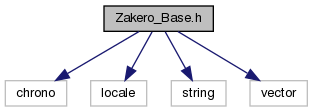
Go to the source code of this file.
Macros | |
| #define | ZAKERO_CONCAT(thing_1_, thing_2_) |
| Concatenate the two things. More... | |
| #define | ZAKERO_DELETE(ptr_) |
| Delete memory. More... | |
| #define | ZAKERO_FREE(ptr_) |
| Free memory. More... | |
| #define | ZAKERO_MACRO_HAS_VALUE(define_) |
| Check if a macro has a value. More... | |
| #define | ZAKERO_PID |
| Get the Process Id. More... | |
| #define | ZAKERO_STEADY_TIME_NOW(unit_) |
| Get the current time. More... | |
| #define | ZAKERO_SYSTEM_TIME_NOW(unit_) |
| Get the current time. More... | |
| #define | ZAKERO_UNUSED(var_) |
| Prevent "unused variable" compilier warnings. More... | |
Enumerations | |
| enum class | zakero::Storage : uint64_t { Byte , Kilobyte , Megabyte , Gigabyte , Terabyte , Petabyte , Exabyte } |
| Conversion Type. More... | |
Functions | |
| double | zakero::convert (const double size, const zakero::Storage from, const zakero::Storage to) noexcept |
| Convert storage sizes. More... | |
| uint64_t | zakero::convert (const uint64_t size, const zakero::Storage from, const zakero::Storage to) noexcept |
| Convert storage sizes. More... | |
| bool | zakero::equalish (const float a, const float b, const float delta) noexcept |
| Compare two floats. More... | |
| std::ostream & | operator<< (std::ostream &stream, const std::error_code &error) noexcept |
| Insert std::error_code into an output stream. More... | |
| bool | zakero::stob (const std::string_view str) noexcept |
| Convert a string into a boolean value. More... | |
| std::string | zakero::to_string (const bool value) noexcept |
| Convert a bool into a string. More... | |
| std::string | zakero::to_string (const std::error_code &error) noexcept |
| Convert an std::error_code to a std::string. More... | |
| std::string | zakero::to_string (std::chrono::nanoseconds nanoseconds) noexcept |
| Convert nanoseconds into a string. More... | |
| std::string | zakero::tolower (std::string str) noexcept |
| Convert a string to lower case. More... | |
| template<class Type > | |
| bool | zakero::vectorContains (const std::vector< Type > &vector, const Type &value) noexcept |
| Check the contents of a std::vector. More... | |
| template<class InputIter , class Type > | |
| bool | zakero::vectorContains (InputIter first, InputIter last, const Type &value) noexcept |
| Check the contents of a std::vector. More... | |
| template<class Type > | |
| auto | zakero::vectorErase (std::vector< Type > &vector, const Type &value) noexcept |
| Erase the contents of a std::vector. More... | |
Detailed Description
Nothing complicated here, just a collection of helper functions, macros, and templates that may be useful in your projects.
Include this header in your source code to use these features.
- Version
v0.9.3
- Added stob()
- Added tolower()
- Added to_string(const bool)
- Added to_string(std::chrono::nanoseconds nanoseconds)
v0.9.2
- Added to_string(std::error_code)
- Added operator<<(std::ostream&, std::error_code)
- Added ZAKERO_DELETE()
- Added ZAKERO_FREE()
- Added ZAKERO_UNUSED()
- Added ZAKERO_PID
- Added equalish()
v0.9.1
- Added macro ZAKERO_STEADY_TIME_NOW()
- Added macro ZAKERO_SYSTEM_TIME_NOW()
- Added vectorErase()
v0.9.0
- The initial collection
- Copyright
- Mozilla Public License v2
Macro Definition Documentation
◆ ZAKERO_CONCAT
| #define ZAKERO_CONCAT | ( | thing_1_, | |
| thing_2_ | |||
| ) |
Use the C/C++ Preprocessor to create a new symbol name. For example the symbol abcxyz could be created using ZAKERO_CONCAT(abc, xyz).
- Example
- int foobar = 1;ZAKERO_CONCAT(foo, bar)++; // foobar == 2int ZAKERO_CONCAT(magic_, 42) = 123;// int magic_42 = 123;#define ZAKERO_CONCAT(thing_1_, thing_2_)Concatenate the two things.Definition: Zakero_Base.h:101
- Parameters
-
thing_1_ Symbol left side thing_2_ Symbol right side
◆ ZAKERO_DELETE
| #define ZAKERO_DELETE | ( | ptr_ | ) |
Using this macro will help catch instances of using a pointer after delete'ing the new'ed memory. It does this by setting the value of ptr_ to nullptr after calling delete.
- Parameters
-
ptr_ The value to free.
- Note
- The
++pandp++syntax should work:ZAKERO_DELETE(p++); ZAKERO_DELETE(p++);
◆ ZAKERO_FREE
| #define ZAKERO_FREE | ( | ptr_ | ) |
Using this macro will help catch instances of using a pointer after free'ing the memory. It does this by setting the value of ptr_ to nullptr after calling free().
- Parameters
-
ptr_ The value to free.
- Note
- The
++pandp++syntax should work:ZAKERO_FREE(p++); ZAKERO_FREE(p++);
◆ ZAKERO_MACRO_HAS_VALUE
| #define ZAKERO_MACRO_HAS_VALUE | ( | define_ | ) |
Use this macro function to determine if a macro has a value and is not just defined.
- Example
- #define BEER#if ZAKERO_MACRO_HAS_VALUE(BEER)#warning I can has beer!#else#error No beer! // <-- This happens#endif
- Parameters
-
define_ The defined macro to check.
◆ ZAKERO_PID
| #define ZAKERO_PID |
Get the ID of the current process.
- Example
- Returns
- The Process Id (
pid_t)
- Note
- POSIX.1-2008
◆ ZAKERO_STEADY_TIME_NOW
| #define ZAKERO_STEADY_TIME_NOW | ( | unit_ | ) |
This macro will get the current time count of the std::chrono::steady_clock.
- Note
- The
std::chrononamespace is automatically prepended to theunit_.
- Example
- auto time_now = ZAKERO_STEADY_TIME_NOW(milliseconds);#define ZAKERO_STEADY_TIME_NOW(unit_)Get the current time.Definition: Zakero_Base.h:205
- Parameters
-
unit_ The time unit to get.
◆ ZAKERO_SYSTEM_TIME_NOW
| #define ZAKERO_SYSTEM_TIME_NOW | ( | unit_ | ) |
This macro will get the current time count of the std::chrono::system_clock.
- Note
- The
std::chrononamespace is automatically prepended to theunit_.
- Example
- auto time_now = ZAKERO_SYSTEM_TIME_NOW(milliseconds);#define ZAKERO_SYSTEM_TIME_NOW(unit_)Get the current time.Definition: Zakero_Base.h:225
- Parameters
-
unit_ The time unit to get.
◆ ZAKERO_UNUSED
| #define ZAKERO_UNUSED | ( | var_ | ) |
- Parameters
-
var_ The "unused variable".
Enumeration Type Documentation
◆ Storage
|
strong |
Function Documentation
◆ convert() [1/2]
|
inlinenoexcept |
Conversion from one storage unit to another is handled by this method. These storage units are in powers of 2.
The difference between this method and zakero::convert(const uint64_t, const zakero::Storage, const zakero::Storage) is that conversions to a larger unit will be a fraction.
- Example
- , zakero::Storage::Gigabyte, zakero::Storage::Byte);, zakero::Storage::Kilobyte, zakero::Storage::Megabyte);uint64_t convert(const uint64_t size, const zakero::Storage from, const zakero::Storage to) noexceptConvert storage sizes.Definition: Zakero_Base.h:292
- Returns
- The converted value.
- Parameters
-
size The size to convert from The source unit to The destination unit
◆ convert() [2/2]
|
inlinenoexcept |
Conversion from one storage unit to another is handled by this method. These storage units are in powers of 2.
Converting to a larger size is rounded down and may result in 0 if the from size is not large enough.
- Example
- uint64_t bytes = zakero::convert(uint64_t(16), zakero::Storage::Gigabyte, zakero::Storage::Byte);uint64_t megs = zakero::convert(uint64_t(16), zakero::Storage::Kilobyte, zakero::Storage::Megabyte);// megs == 0
- Returns
- The converted value.
- Parameters
-
size The size to convert from The source unit to The destination unit
◆ equalish()
|
inlinenoexcept |
Compare two floats for some degree of equality. For the float values to be considered "equal", the difference between the values must be less than the specified delta.
- Return values
-
true The values are equal false The values are not equal
- Parameters
-
a The first value b The second value delta The maximum difference
◆ operator<<()
|
inlinenoexcept |
- Returns
- The
stream.
- Parameters
-
stream The stream to use error The value in insert into the stream
◆ stob()
|
inlinenoexcept |
- Todo:
- Make the list of "true" string values convertible.
(Compile-Time or Run-Time?)
This is intended to be a complement to the std::stod() and std::stoi() family of functions. However, the main restriction is this method only accepts certain string values to represent a boolean true value:
- "enable"
- "enabled"
- "true"
- "t"
- "yes"
- "y"
- "1" If the provided
stris not one of the above strings,falsewill be returned.
- Note
- The string comparison is not case-sensitive.
- Returns
- The string converted to a boolean value.
- Parameters
-
str The value to convert.
◆ to_string() [1/3]
|
inlinenoexcept |
Converts a bool value in to either "true" or "false".
- Returns
- A string
- Parameters
-
value The value
◆ to_string() [2/3]
|
inlinenoexcept |
The provided error will be converted to a string.
- Returns
- A string
- Parameters
-
error The value
◆ to_string() [3/3]
|
inlinenoexcept |
The nanoseconds value will be converted into a string that contains "days", "hours", "minutes", "seconds", and (of course) "nanoseconds".
- Returns
- A string
- Parameters
-
nanoseconds The value
◆ tolower()
|
inlinenoexcept |
The provided string, str, will be converted to lower-case using the default locale.
- Returns
- The lower-case string.
- Parameters
-
str The string to convert
◆ vectorContains() [1/2]
|
inlinenoexcept |
A convience method to make searching a vector easier, like std::map::contains().
- Example
- std::vector<int> v = { 0, 1, 2, 3 };if(vectorContains(v, 1)){// Found it}bool vectorContains(const std::vector< Type > &vector, const Type &value) noexceptCheck the contents of a std::vector.Definition: Zakero_Base.h:404
- Return values
-
true The valuewas found.false The valuewas not found.
- Parameters
-
vector The vector to search value The value to look for
◆ vectorContains() [2/2]
|
inlinenoexcept |
A convenience method to make searching a vector easier. While this method does not save that many keystrokes, it does lead to more readable code.
- Example
- std::vector<int> v = { 0, 1, 2, 3 };if(vectorContains(std::begin(v), std::end(v), 1){// Found it}// Compare with the "long" form, the// value that is searched for gets lost// very easily.if(std::find(std::begin(v), std::end(v), 1) != std::end(v)){// Found it}
- Return values
-
true The valuewas found.false The valuewas not found.
- Parameters
-
first Start searching here last Stop searching here value The value to look for
◆ vectorErase()
|
inlinenoexcept |
A convenience method to make removing content from a vector easier.
Uses the "Erase/Remove Idiom".
- Example
- std::vector<int> v = { 0, 1, 2, 3 };vectorErase(v, 2);// v = { 0, 1, 3 };auto vectorErase(std::vector< Type > &vector, const Type &value) noexceptErase the contents of a std::vector.Definition: Zakero_Base.h:476
- Return values
-
true The valuewas found.false The valuewas not found.
- Parameters
-
vector The vector to search value The value to look for